Read your analytics without fooling yourself
Answer rate is the easiest number to improve and the easiest to be misled by. Read it next to something that keeps it honest.
A high answer rate can mean the bot is guessing
Any assistant can reach a perfect answer rate by never refusing. That number on its own rewards exactly the behaviour you are trying to avoid, so reading it alone will lead you to the wrong conclusion.
- Answer rate reported without refusal volume beside it
- Rising automation metrics alongside falling satisfaction
- No connection drawn between content changes and outcomes
- Sentiment tracked but never acted on
Answer rate, with refusals beside it
Answer rate is the share of conversations the bot answered rather than refused. Read it next to refusal volume: rising answers with falling refusals means coverage improved, while rising answers with flat refusals may mean it is attempting more than it should.
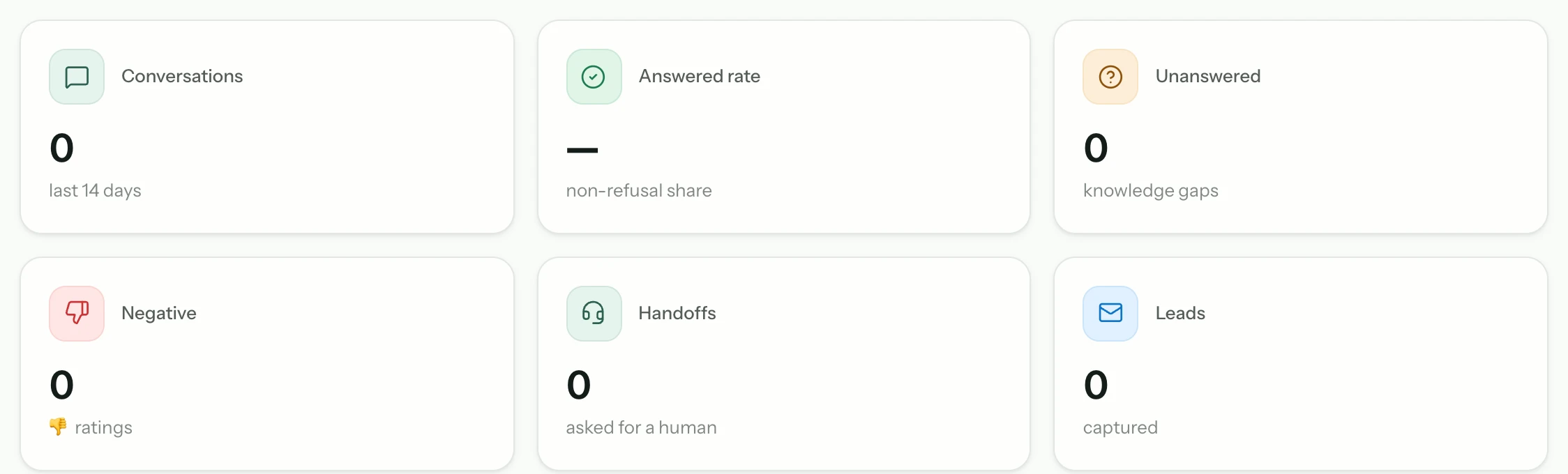
Volume, split by hour
Total conversations tells you demand; the hourly split tells you how much of it falls outside your staffed hours. That second number is usually the strongest argument for the whole exercise.
Sentiment as a tripwire
Sentiment is not precise enough to optimise against, but a sudden decline is a reliable signal that something changed — a page went stale, a policy shifted, or the bot started answering something it should decline. Treat it as an alarm rather than a target.
Content gaps as the action list
This is the only view that tells you what to do next. Write the top item, wait for the next crawl, and watch both that question's frequency and your overall refusal rate fall. That loop is the whole operating model.
Work top-down
Ranked by demand, so the first item is the highest-value page.
Re-check after a crawl
Confirm the fix landed rather than assuming it did.
Common questions
- What is a good answer rate?
- There is no universal number, because it depends entirely on how much of your domain your content covers. A better question is whether it is improving as you fill gaps, and whether satisfaction is holding while it does.
- Should I try to get refusals to zero?
- No. Some questions genuinely should be refused — account-specific, advisory, or out of scope. A zero refusal rate would mean it had started answering those, which is the outcome you are trying to prevent.
- How quickly do content changes show up?
- After the next crawl picks up the published page. Check the source list to confirm the new page was indexed before concluding the fix did not work.
From the blog
All posts- MeasuringResolution rate vs deflection: stop mixing the twoResolution and deflection answer different questions. Mixing them inflates the result and hides whether customers actually got what they needed.Read
- MeasuringSatisfaction must travel with every automation numberNever report deflection, containment, or answer rate alone. Pair every automation figure with the same satisfaction instrument you used before launch.Read
- EvaluatingHow to shortlist AI support tools without a feature matrixSkip the 40-row comparison spreadsheet. A behaviour-first shortlist — refusal, paraphrase, citation, handoff — ranks vendors on what customers feel.Read



Answer honestly. Capture the rest.
Point Matter Chat at your site and see what it can — and can't — answer. It's honest about both.
No credit card. 2 minute setup.
Every answer cites the source it came from. When there isn't one, it says so — and hands the visitor to you.


Installs on the tools you already run.