Stop your assistant from inventing answers
The architecture prevents most of it. The rest is configuration and testing you have to do deliberately.
A confident wrong answer is the expensive failure
A refusal costs a little goodwill. An invented refund policy that a customer acts on costs the refund, the trust, and often the account. The two failures are not remotely comparable, which is why the system is built to prefer the first.
- Answers that sound authoritative and cite nothing
- Policies stated that appear nowhere on your site
- Confident replies about features that do not exist
- No process for testing accuracy before launch
Rely on grounding, then verify it
Answers are generated from retrieved passages of your content rather than from model memory, and every answer carries the source. Check the citation rather than the answer when testing: a correct answer citing an unrelated page means retrieval is not working and will fail on the next question.
Write explicit refusal rules
In the persona settings, name the categories it must decline — individual account questions, quotes, advice. Explicit boundaries are more dependable than assuming the absence of content will produce a refusal.
Remove content that invites bad answers
Outdated pages, superseded pricing, and old policy documents are worse than missing content, because they will be retrieved and cited confidently. Indexing an archive is a common cause of authoritative wrong answers.
Prune stale pages
An old pricing page will be cited as current.
Watch the citations
They tell you which pages are producing bad answers.
Test adversarially before launch
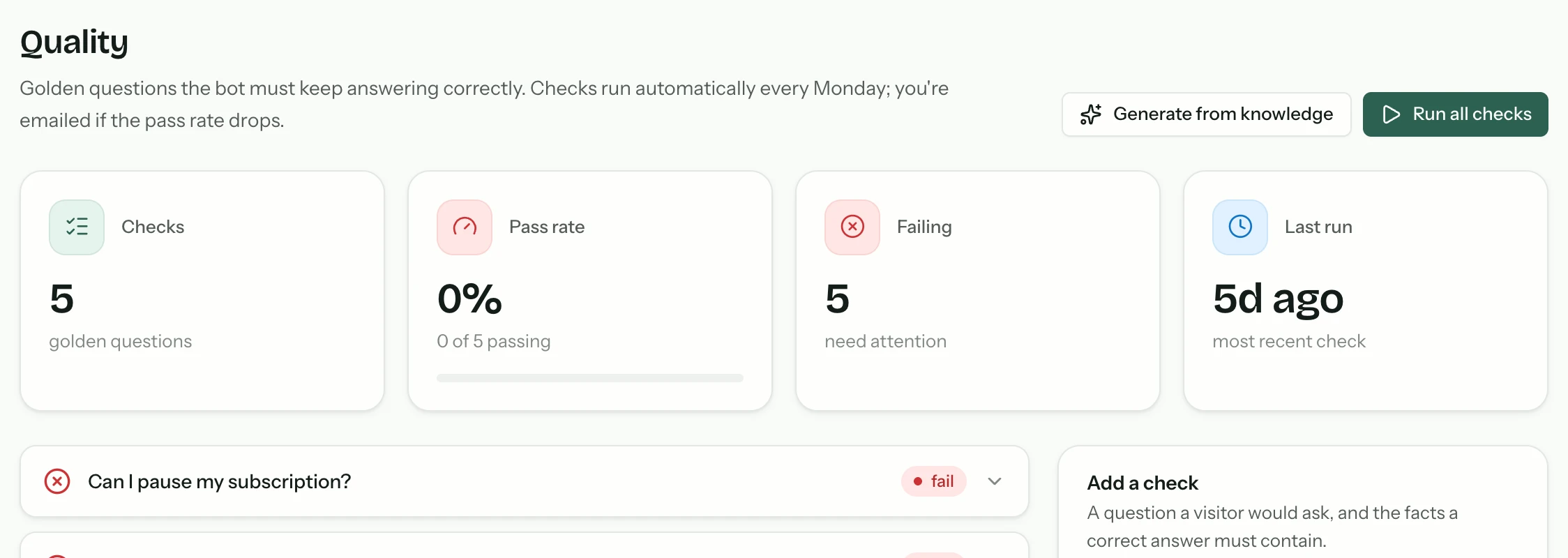
Do not only ask questions you know it can answer. Ask things that are plausible but uncovered, things adjacent to your content, and things you explicitly told it to refuse. That is where invention shows up, and it is far cheaper to find it yourself.
Common questions
- Can hallucination be eliminated completely?
- Grounding and refusal remove the common case — inventing facts from model memory — but no system that generates language can be guaranteed. That is exactly why every answer carries a citation: it makes verification a click rather than an act of faith.
- What is the single most effective control?
- Pruning stale content. Wrong-but-indexed pages produce confident wrong answers with a citation attached, which is more dangerous than a gap because it looks trustworthy.
- How often should I re-test?
- After any significant content change, and periodically otherwise. Sampling logged conversations is the low-effort version and catches most drift.
From the blog
All posts- EvaluatingWhen “I don’t know” is the correct product behaviourAssistants that always answer look helpful in demos and dangerous in production. When refusal is the right behaviour — and how to evaluate it.Read
- BuildingGrounding without the mystiqueStrip the jargon and grounding is simple — supply the passages, require the model to use them, refuse when they are missing. Here is how to check it is actually happening.Read
- BuildingWhat to index first when your site is a messStart with the pages that already resolve real support questions. Noise, archives, and unfinished docs can wait — indexing them first makes answers worse.Read




Answer honestly. Capture the rest.
Point Matter Chat at your site and see what it can — and can't — answer. It's honest about both.
No credit card. 2 minute setup.
Every answer cites the source it came from. When there isn't one, it says so — and hands the visitor to you.


Installs on the tools you already run.