Find and fill the questions your content never answers
You have a ranked list of things your customers wanted to know and could not find out. That is a better content plan than any keyword tool will give you.
Content plans are usually guesses
Editorial calendars are built from keyword volume, competitor pages, and opinion. None of those tell you what a person on your site wanted and did not get, which is the only question a help centre exists to answer.
- Articles written on topics nobody asked about
- Recurring support questions with no article behind them
- Keyword tools suggesting terms your customers never use
- No feedback loop between support and content
Open the gap report
Every question the assistant could not answer is logged and grouped by similarity, then ranked by how often it was asked. The top of that list is the single highest-value page you could write this week.
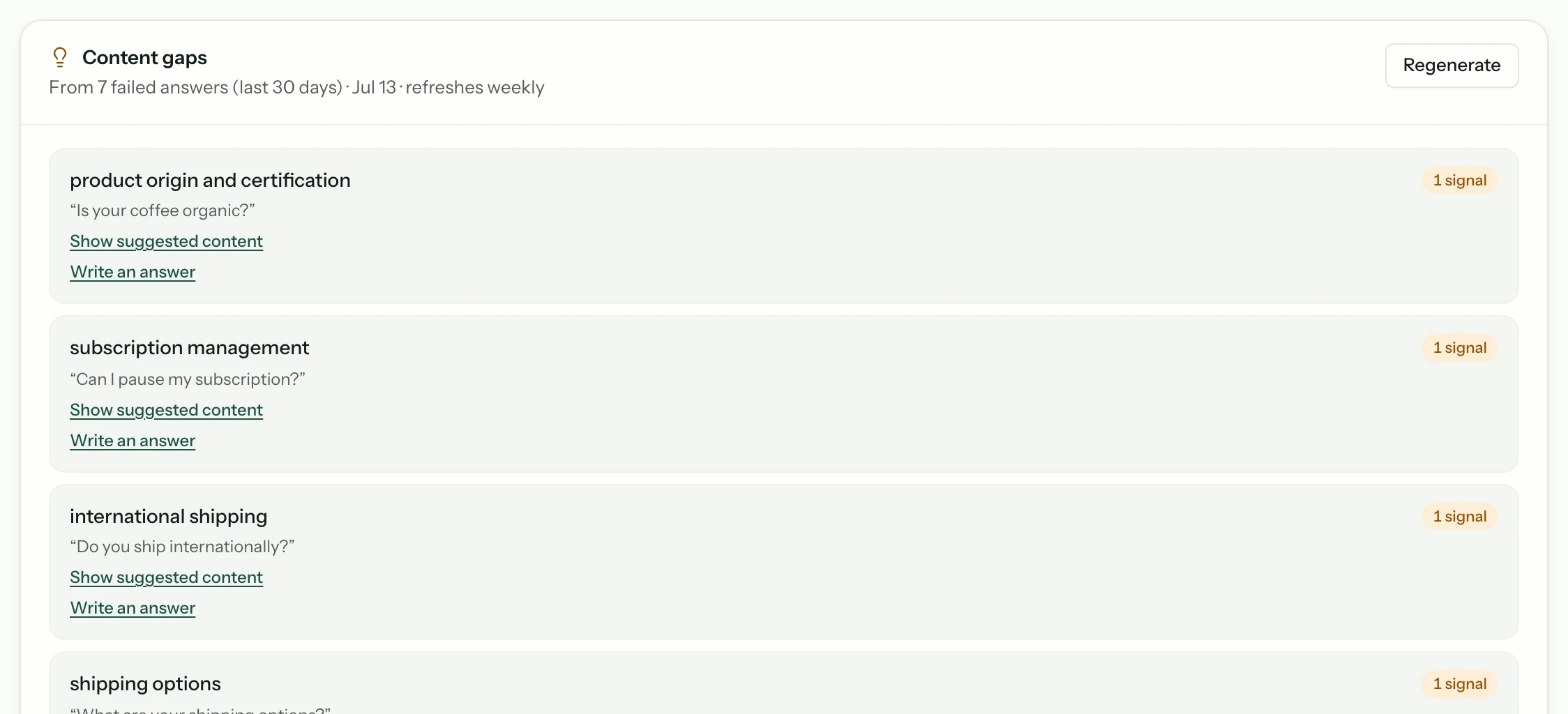
Read the phrasing, not just the topic
The report keeps the wording people used. That phrasing is usually a better title and a better set of headings than the ones you would have chosen, because it is how the question is actually asked rather than how you name the feature internally.
Write the page and publish it
Answer the question directly and near the top. Content written for an assistant to retrieve wants the answer stated plainly rather than built up to over four paragraphs of preamble.
Answer first
State it, then explain. Retrieval finds direct statements.
Use their words
Include the phrasing from the report as a heading.
Confirm it closed the gap
After the next crawl, ask the question yourself and check both the answer and the citation. Then watch that item's frequency in the report — if it is still climbing, the page did not actually answer what was being asked.
Common questions
- How many gaps should I fix at once?
- Work down the list rather than in bulk. Ranked by demand means the first item is worth more than the next five combined, and fixing one at a time keeps the feedback loop legible.
- What if a gap is something we deliberately do not answer?
- Leave it. Some questions should be refused — pricing you negotiate individually, advice you are not qualified to give. A permanent entry in the gap list is fine when the refusal is the correct behaviour.
- Can I use this for SEO as well as support?
- Yes, and it is unusually good for it: these are questions real people asked on your site, phrased as they would search for them, ranked by demand you have already observed.
From the blog
All posts- EvaluatingHow to test an AI support tool before you trust itEvery AI support tool demos well, because demos ask questions the content covers. Four questions that separate them, and what a good answer looks like.Read
- BuildingWriting help pages an assistant can actually retrieveAnswer early, name headings like questions, keep one topic per page, and put facts in text. Retrieval fails on structure more often than on “AI”.Read
- BuildingEscalation that keeps the conversation contextHand over on refusal and on request, send the full transcript, and be honest about office hours. Context is the whole point of escalation.Read




Answer honestly. Capture the rest.
Point Matter Chat at your site and see what it can — and can't — answer. It's honest about both.
No credit card. 2 minute setup.
Every answer cites the source it came from. When there isn't one, it says so — and hands the visitor to you.


Installs on the tools you already run.