Support every language your customers write in
You do not have a Spanish help centre, a German one, and a Japanese one. You have one, and customers who do not read it in English.
No credit card. No second help centre.

Wie lange dauert der Versand nach Österreich?
Standardversand nach Österreich dauert 3–5 Werktage. Ab 50 € ist der Versand kostenlos.
Shipping & delivery- Answers in their language
- Detected from the question, not from a picker nobody finds.
- Content maintained once
- No second help centre to keep in sync.
- Citations still work
- The link points at your real source page.
- Refuses in every language
- The honesty does not degrade outside English.

Going international multiplies the support surface
Every new market is another language of inbound and, in theory, another translated help centre to maintain. In practice the translation lags, so international customers get a worse answer than domestic ones — or they get English and are expected to cope.
- Support quality drops noticeably outside your primary language
- Translated help articles fall behind the originals after the first quarter
- You cannot hire a native speaker for every market you sell into
- Non-English questions sit in the queue longest
One knowledge base, every market
The usual approach to going international is a translated help centre per market, which falls behind the original within two quarters. Answering in the language of the question from a single maintained source removes the sync problem entirely.
Detected, not selected
The language comes from what the visitor wrote. Language pickers are consistently ignored.
Written once
Your source pages stay in one language; the answers do not have to.
Verifiable everywhere
The citation points at the page the answer came from, so it stays checkable in any language.
The same refusal behaviour
Which matters most here — fabrication is hardest to catch in a language nobody on your team reads.
Timezones you do not staff
International markets ask at their evening, which is the middle of your night.
Demand by market
Conversations are logged as asked, so you can see which languages generate real volume before you localise.
Written in one language, answered in theirs
The bot understands the question in the language it arrives in and answers in that language, drawing on the content you maintain in one place. There is no second help centre to keep in sync, because there is no second help centre.
- Reply in the asker's language
- Whatever they type in, the answer comes back in.
- Maintain content once
- Nothing forks. One page to edit when the policy changes, whatever the reader speaks.
- Citations still work
- A reader can open the source and check it, even when it is not in their language.
The same honesty in every language
Refusal behaviour does not change with the language. A question your content does not cover gets a plain 'I do not know' and a route to a human in that language, rather than a fluent invention — which is a particular risk when nobody on your team can read the reply to check it.
See demand by market
Because questions and refusals are logged as asked, you can see which markets are generating volume and which questions they are asking. That is usually a better signal of where to localise properly than a forecast.
Fluent is not the same as correct
A model will happily invent a policy in flawless German, and the failure is far harder to catch than it would be in English, because nobody on your team is reading it. So the safeguard has to be the same rule everywhere: a passage in your content, or a plain refusal.
- The reply follows the language of the question, not a picker
- The refusal follows it too — no confident invention outside English
- Citations point at the source page you actually maintain
- Conversations are stored in full, so a speaker can sample them
Precision is still better in the languages you publish in. Translating your source pages improves the answers in that language; it is just not a prerequisite for answering at all.

- ESNo tengo esa información en la documentación.
- DEDazu habe ich keine Information in der Dokumentation.
- FRJe n’ai pas cette information dans la documentation.
Same rule, every language
Setting it up, and checking it honestly
There is almost no configuration. The work is in the verification, and specifically in the step most teams skip.
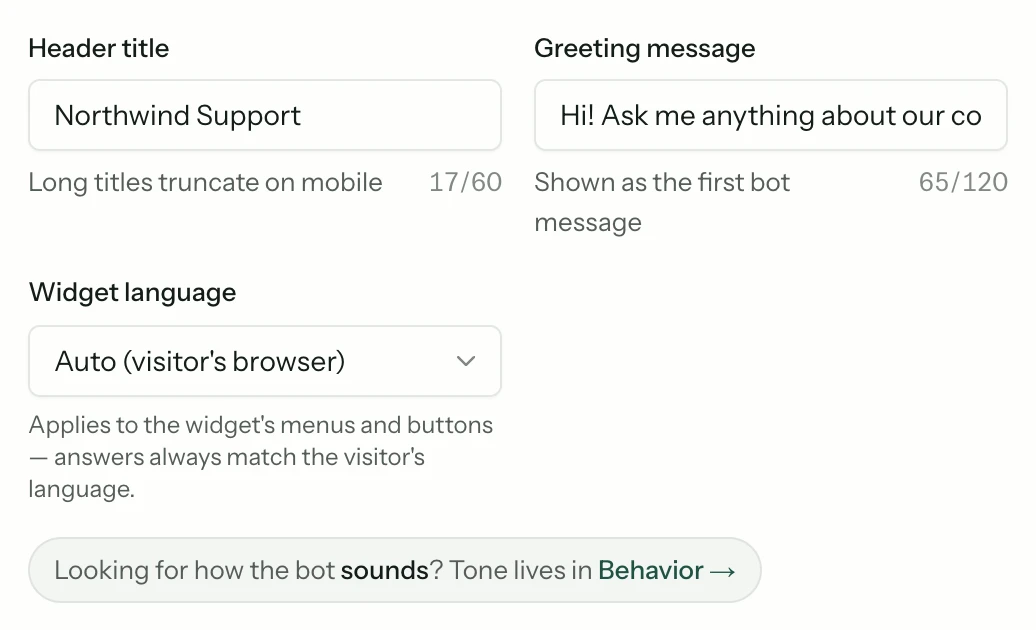
- 1
Index what you already maintain
In whatever language you maintain it. There is no per-language setup, because answers are generated from that single source.
- 2
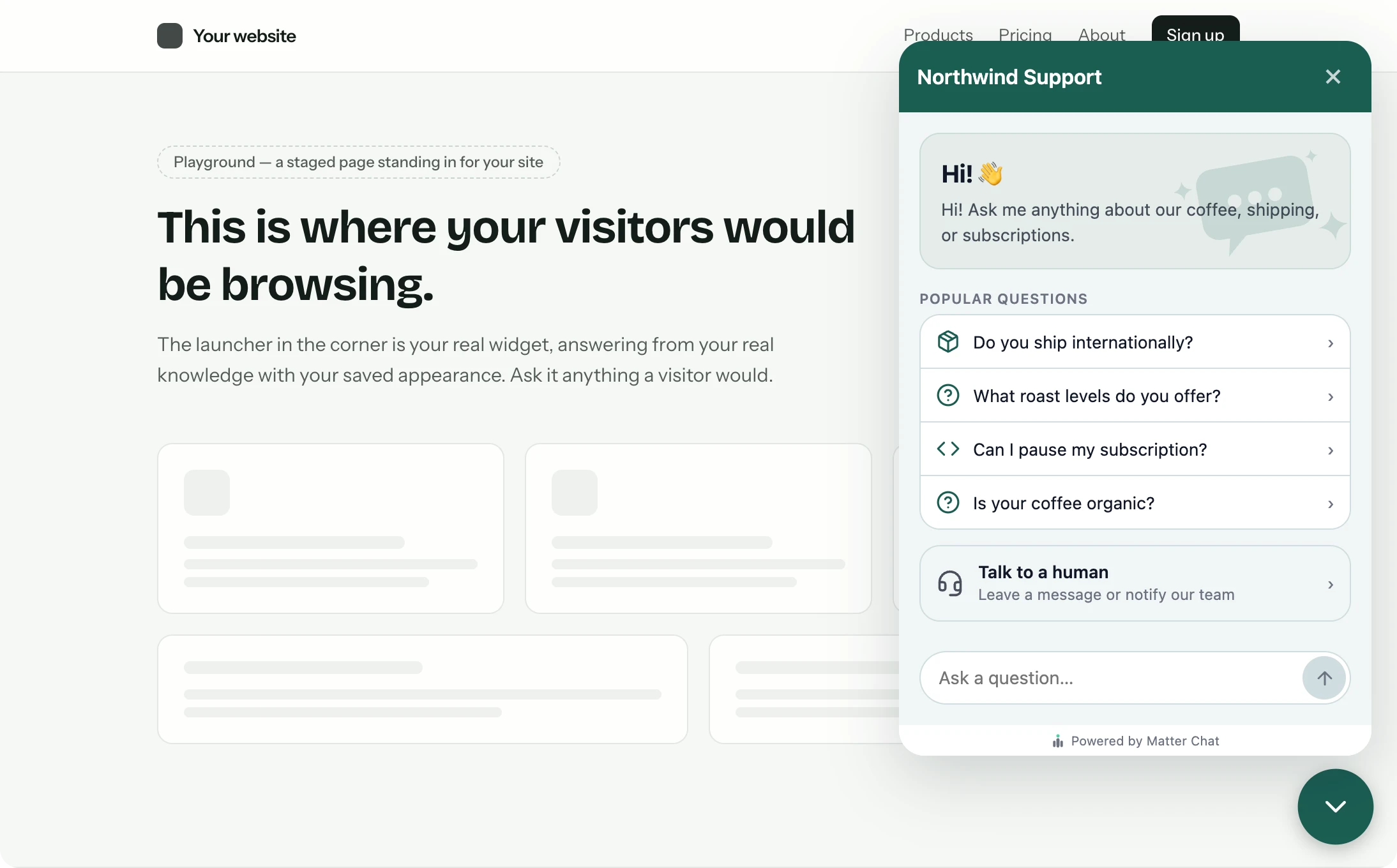
Leave the language on auto
Widget language sets the menus and buttons. Answers follow the question regardless, so auto is usually correct.
- 3
Test the boundary, not the greeting
Ask something outside your content in each language you expect and confirm you get a refusal, not a fluent invention.
- 4
Have a speaker sample the logs
Conversations are stored in full. A periodic review by a native speaker is the practical quality control.
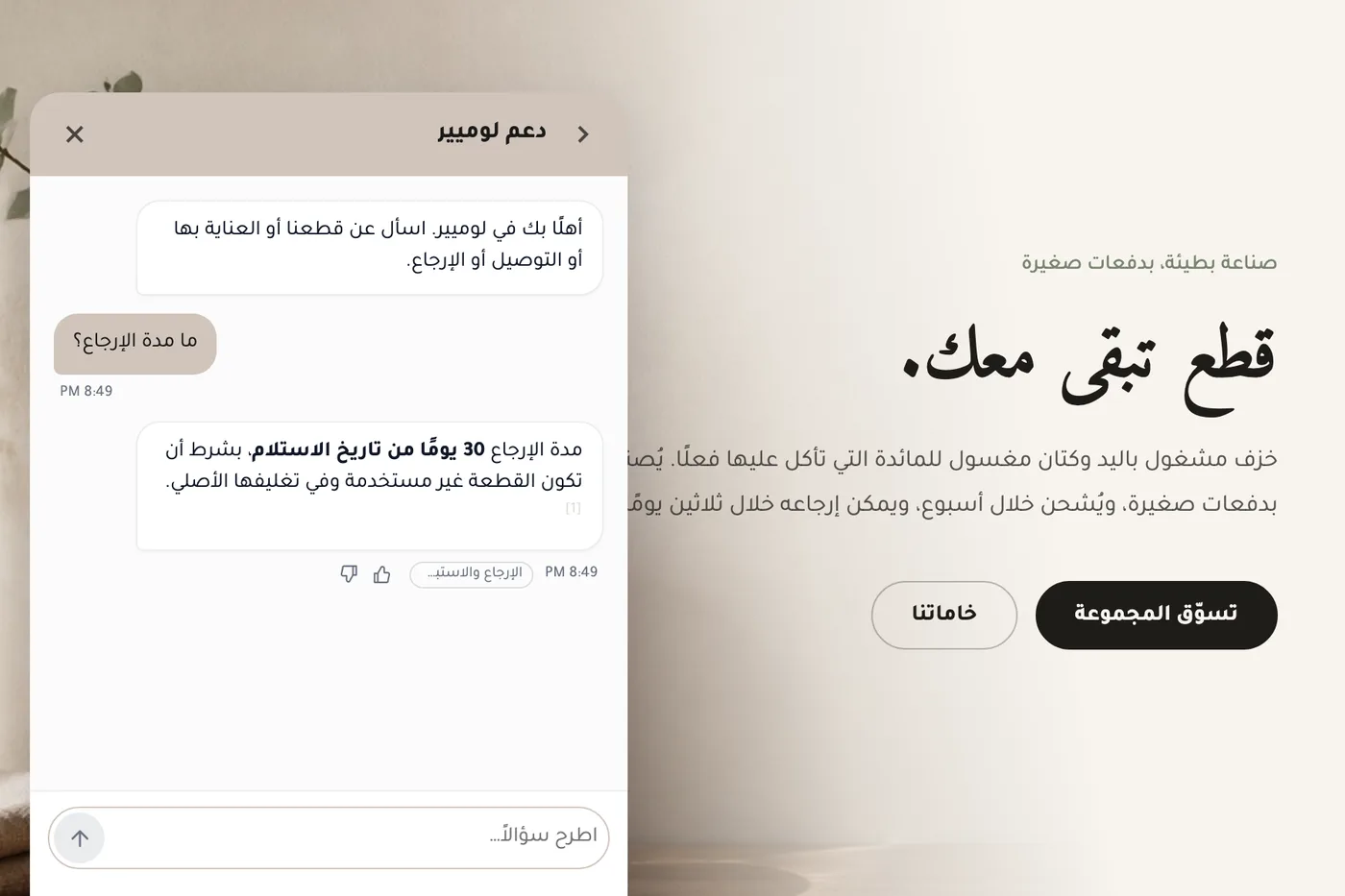
See it working
Ask it in Arabic.
The same LUMIÈRE shop, written in Arabic and laid out right to left. The assistant was given the shop’s policies in Arabic and nothing else. Ask in Arabic and it answers in Arabic, from those policies — and declines what they do not cover.
Open the Arabic demoOpens in a new tab. Nothing to sign up for, and nothing is for sale.

Four things worth asking it — paste them in as they are
ما مدة الإرجاع؟
“What is your return window?” — 30 days, unused, original packaging
هل تشحنون إلى السعودية وكم تستغرق؟
“Do you ship to Saudi Arabia?” No page names it; it files it under rest of world, 6–12 days
هل الخزف آمن لغسالة الصحون؟
“Is the stoneware dishwasher safe?” — any cycle, and the one thing that cracks it
هل تغلفون الهدايا؟
“Do you gift wrap?” Nothing says. It declines and points to the team
Before you sell into another market
Short answers. If yours is not here, the assistant on this page will try it — and tell you honestly if it cannot.
Do I need to translate my documentation first?
No. The bot works from the content you have and answers in the language of the question. Translating your source material improves precision in that language, but it is not a prerequisite for answering at all.
How do I check the quality of answers in a language nobody on my team reads?
Conversations are logged in full, so they can be reviewed or sampled by a native speaker. The refusal behaviour matters most here: because the bot declines rather than improvises, the failure mode in an unreviewed language is silence rather than confident fabrication.
Does the citation link to a translated page?
It links to the source page the answer came from, which is the page you actually maintain. If you publish a translated version of that page and it is indexed, that becomes citable too.
Keep reading
All solutions



From the blog
All posts- EvaluatingWhat supporting Arabic properly asks of an AI chat widgetWhat correct Arabic support in an AI chat widget involves — right-to-left layout, mixed-direction text, reply language, citations and search — how Matter Chat handles each, where it still falls short, and a live Arabic demo store to test it on.Read
- EvaluatingEvaluating multilingual AI support without a language you speakHow to evaluate multilingual AI support when you cannot read every reply: locked facts, paraphrase pairs, citation checks, and handoff — without trusting the demo language switch.Read
- EvaluatingHow to test an AI support tool before you trust itEvery AI support tool demos well, because demos ask questions the content covers. Four questions that separate them, and what a good answer looks like.Read



Answer honestly. Capture the rest.
Point Matter Chat at your site and see what it can — and can't — answer. It's honest about both.
No credit card. 2 minute setup.
Every answer cites the source it came from. When there isn't one, it says so — and hands the visitor to you.


Installs on the tools you already run.