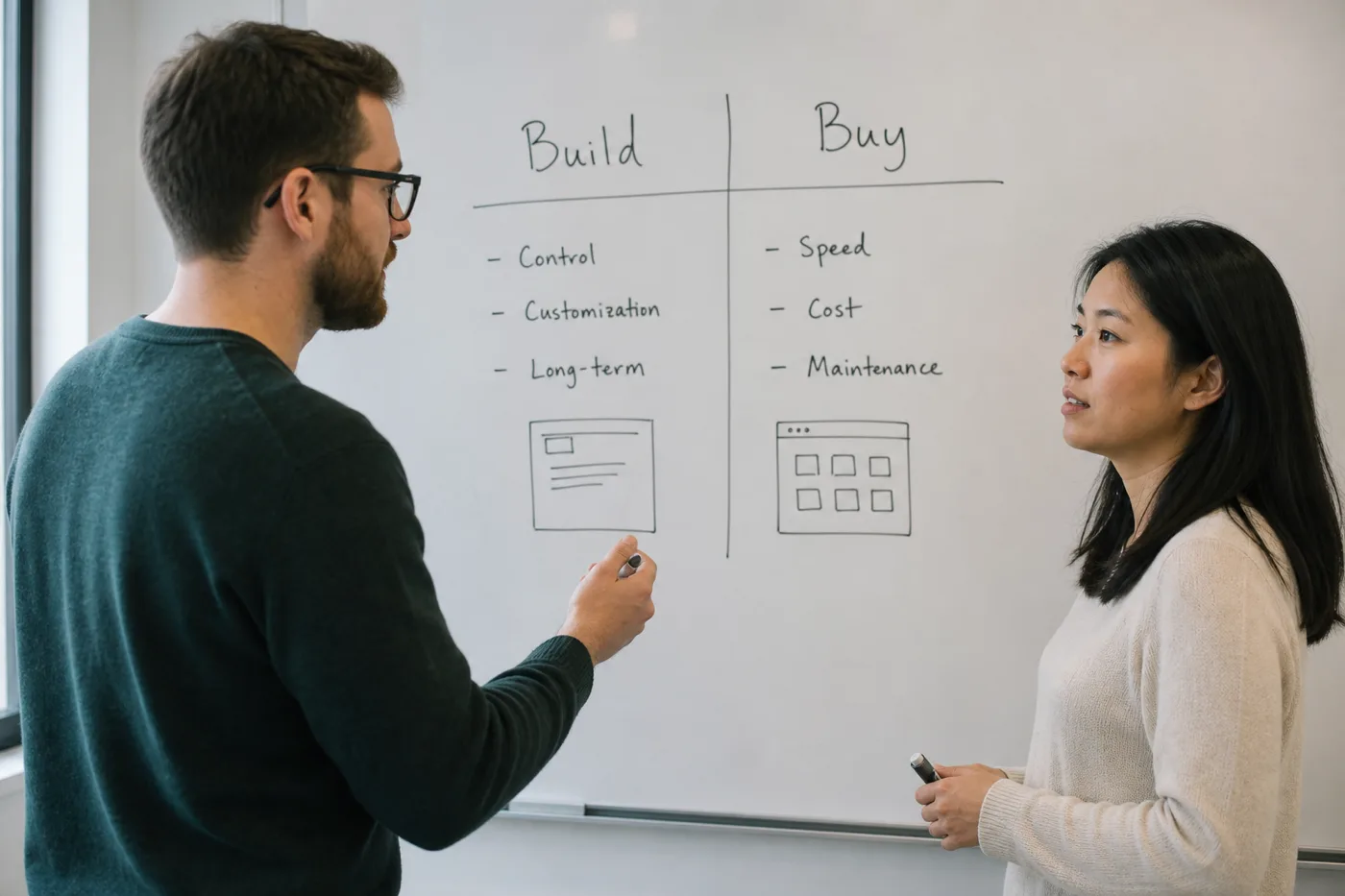
The usual build-vs-buy conversation for website support starts in the wrong place. Someone wires a model to a help centre dump, ships a floating bubble, and calls it a build. Someone else opens a feature matrix and calls it a buy. Neither exercise answers the question that decides outcomes six months later: who will own the boring loop when the assistant is wrong, silent, or out of date?
This post is the version without that trap. We sell a bought product, so read us sceptically. The framework still holds if you conclude you should build — or conclude you should buy from someone else.
What you are actually deciding
A website support assistant is not “chat UI + LLM”. It is a small operating system: crawl or ingest, chunking, retrieval, grounding rules, refusal, citations, escalation into a human queue, analytics you can defend, and spend controls so a bad week does not become an invoice event. The model call is the easy middle.
- Who notices when a staging domain pollutes answers?
- Who re-crawls after a docs rewrite, and how fast?
- Who reads the refusal list and turns it into pages?
- Who owns the handoff when a visitor asks for a person in one turn?
When building is the rational choice
Build if the assistant is a core differentiator with constraints no vendor will meet soon — unusual data boundaries, deep in-product actions, or a support topology so specific that a generic widget would be a permanent compromise. Build also if you already have the team that will treat knowledge ops as a standing duty, not a launch project.
| Signal | Why it matters |
|---|---|
| You need tool-use inside authenticated product state | Website FAQ retrieval is the wrong abstraction |
| Compliance requires a stack you already run | Vendor fit may be secondary to control |
| You have owners for crawl, eval, and escalation | Without owners, build becomes silent decay |
| The widget is a thin skin over existing search infra | You may already own the hard part |
If none of those are true, “we can build it” is often a statement about capability, not about priority. Capability is not the scarce resource. Attention is.
When buying is the rational choice
Buy when your advantage is the content and the customer relationship, not the retrieval plumbing. Most teams in this category need a trustworthy public assistant on a marketing or docs site, a clean decline when the pages do not cover the question, and an escalation that does not erase context. That problem is well-shaped for a product — provided you evaluate behaviours, not logos.
The longer comparison lives at build vs buy for AI support. The short version for website support: if your roadmap item is “answer from our site without inventing”, you are shopping for an operated system, not a model wrapper.
The cost lines people skip
- Evaluation harness: paraphrase sets, gap questions and citation checks, re-run on a schedule.
- Content loop: content gaps only shrink if someone writes pages.
- Incident response: wrong public answers need a kill switch and a postmortem path.
- Integration drift: helpdesk fields, CRM routing, and domain locks change under you.
Bought software moves some of that into a vendor’s release train, though your content stays yours to own either way. Built software keeps the release train and puts your name on the on-call rota. Price the rota honestly.
A decision test that avoids the trap
Before you choose, run the same behavioural bake-off you would use on vendors — on a prototype if you are building, on a trial if you are buying. Outside-content refusal, paraphrase consistency, citation claim-check, one-turn human handoff. Our version is in how to test an AI support tool. If your build fails those and a vendor passes, “strategic control” is an expensive story. If every vendor fails and your build passes on your constraints, buy was never the point.
“Build vs buy is not “do we have engineers?”. It is “do we want to operate this failure mode ourselves?”.”
How to use Matter Chat in that decision
Use us as one data point in the bake-off, not as the definition of buy. If Matter Chat invents on your gap question, or cites a page that does not contain the claim, or buries the handoff, that is information — about us, and about how strict your bar should be for anyone else. If we pass and building would mostly recreate crawl, grounding, and escalation, the usual trap is building anyway to feel ownership. Ownership of the inbox outcomes matters more than ownership of the websocket.
Either path still needs the same post-launch discipline: baseline tickets, read refusals, keep satisfaction beside every automation number. The tool choice does not excuse skipping measurement.